
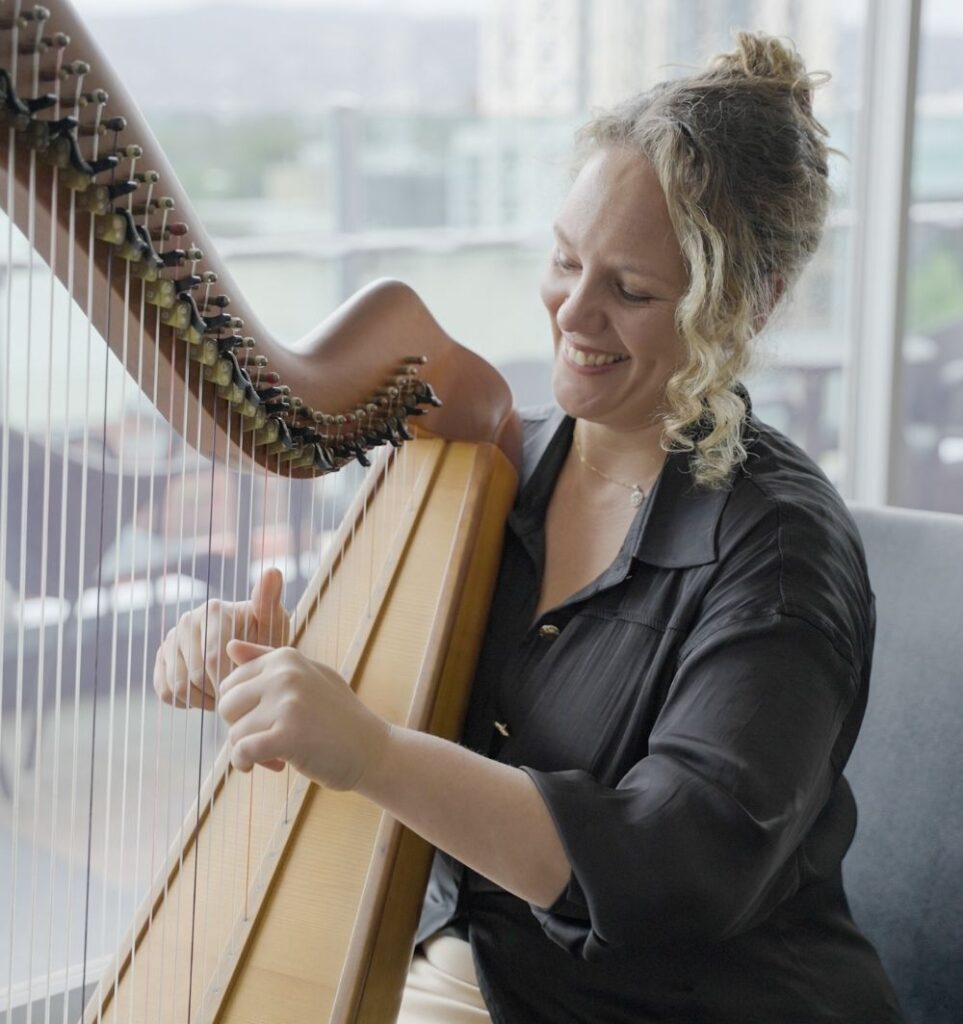
When I first heard the harp as a child, I was captivated. There was something about the way it speaks softly—how it invites attention rather than demands it.
Recently, I’ve started playing for myself and others again: solo pieces, modal improvisation, and sharing music in ways I haven’t for years. My harp has been like an old friend over the decades—sometimes close, sometimes quietly waiting—but always there when I return.
I began learning young, but those early years were challenging. The harp is a complex instrument: two hands doing different things, coordinating bass and treble, managing levers, tuning, technique, and theory all at once. Traditional teaching approaches at the time often leaned heavily on sight reading, theory and set tunes – often wrapped in a sense of never quite being “good enough.” Over time, that pressure drained the joy out of playing. Eventually, I stepped away.
I returned in my twenties with a new teacher—and with the confidence and maturity to say what I wanted from learning. Then life shifted again. Children arrived, priorities changed, and the harp took a gentle back seat.
And now, in this season of setting up my business and embracing creativity as a core part of who I am, I’m playing again—this time for joy. For myself. For others. And alongside a wonderful group of harpists who make the music communal, playful, and deeply human.
What I’ve realised is that the harp isn’t just teaching me music.
It’s teaching me how to work with people—and how to navigate complexity, especially now, when so many of us are tired, stretched, and juggling a lot under pressure.
What the harp is teaching me
🎵 1. Often, it’s the journey that brings the solution
Reaching straight for the “big answer” too soon—like trying to play perfectly before building foundations—usually trips us up.
When we focus only on outcomes, complexity becomes overwhelming. But when we start simple, stay curious, and allow room to play, the right solution often emerges naturally—much like building muscle memory over time.
In work, this translates to how we work with others: using clear, shared language; breaking problems into manageable pieces; and creating a soft entry point into conversations—through connection, a smile, or a moment of humour. These small human gestures build trust, making it possible to navigate complexity together and create the space where real progress happens.
🎵 2. Patterns make complexity navigable
In music, simple patterns guide improvisation. They give you something to return to when things feel uncertain.
The same is true in organisations. Clear objectives, shared values, and agreed ways of working create stability. When things get messy—and they inevitably do—these patterns help people orient themselves and move forward together.
🎵 🖌️ 3. Creativity is the door to innovation
Just as it’s unrealistic to expect most musicians to sight-read flawlessly, it’s unrealistic to expect perfect answers to complex policy problems. And even if we could produce them, we’d still need fresh ideas.
Improvisation reminds us that creativity is rarely neat. It can feel uncertain—even risky—to try something new without knowing exactly where it will land. But when you’re grounded in a core tune—the shared objectives, the agreed direction—you have the groundwork to move forward, even when the next step isn’t yet clear.
That structure doesn’t limit exploration; it makes it possible. It allows us to take risks, test ideas, learn, adapt, and discover answers we would never reach by following the sheet music alone. Inviting creativity into problem-solving—through divergent thinking and by giving people space to think differently—opens possibilities that logic alone can’t reach.
Returning to the harp has reminded me that complexity doesn’t need to be forced or conquered. It asks to be listened to, worked with patiently, and approached with curiosity and a willingness to play.